Intrathecal Clonidine Versus Midazolam as an Adjuvant to Hyperbaric Bupivacaine for Lower Limb Surgery: A Prospective Comparative Study
DOI:
https://doi.org/10.62644/iajlb.2026.v23.i3.pp103-111Abstract
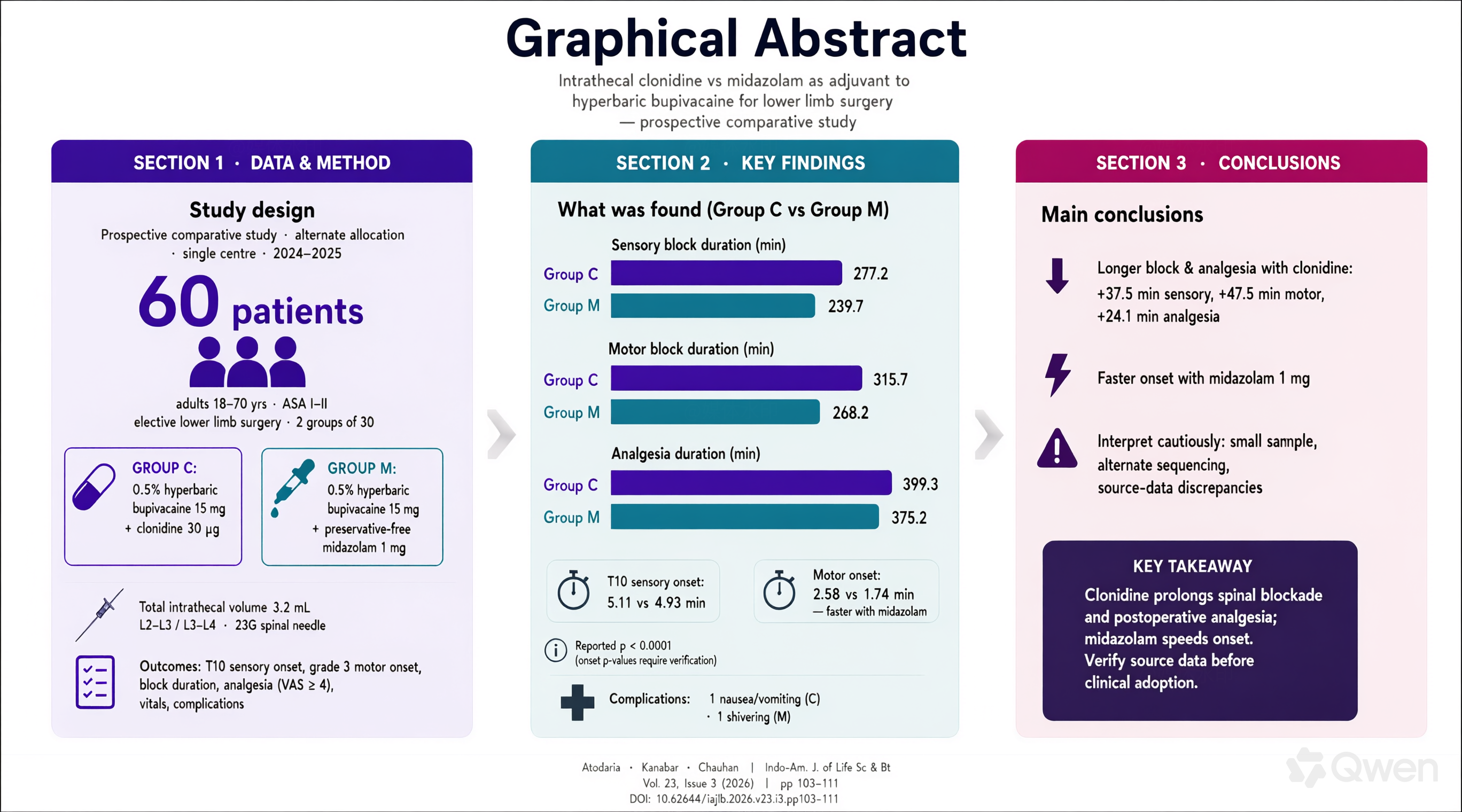
Background: Intrathecal adjuvants are used with local anaesthetics to modify the onset and duration of spinal blockade and postoperative analgesia. This study compared clonidine and preservative-free midazolam as adjuvants to hyperbaric bupivacaine in patients undergoing elective lower limb surgery. Methods: In this prospective comparative study, 60 adults aged 18–70 years with American Society of Anesthesiologists physical status I or II were assigned by alternate sequencing to two groups of 30. The clonidine group received 15 mg of 0.5% hyperbaric bupivacaine with clonidine 30 µg; the midazolam group received the same dose of bupivacaine with preservative-free midazolam 1 mg. Sensory and motor block characteristics, time to first rescue analgesia, perioperative vital signs and complications were assessed. Results: Mean time to T10 sensory blockade was 5.11 versus 4.93 minutes, and mean time to grade 3 motor blockade was 2.58 versus 1.74 minutes, in the clonidine and midazolam groups, respectively. Mean sensory block duration was 277.2 versus 239.7 minutes, motor block duration was 315.7 versus 268.2 minutes, and analgesia duration was 399.3 versus 375.2 minutes. The dissertation reported p less than 0.0001 for these comparisons, although the onset p-values require verification. One patient in the clonidine group experienced nausea and vomiting; one in the midazolam group experienced shivering. Conclusion: At the doses studied, clonidine was associated with longer sensory and motor blockade and a longer interval to first rescue analgesia, whereas midazolam was associated with shorter onset times. The findings require cautious interpretation because allocation was by alternate sequencing, the sample was small, and discrepancies in the source data need clarification.References
1. Morgan GE Jr, Mikhail MS, Murray MJ. Clinical anesthesiology. 4th ed. New York: McGraw-Hill Medical; 2006.
2. Swain A, Nag DS, Sahu S, Samaddar DP. Adjuvants to local anesthetics: current understanding and future trends. World J Clin Cases. 2017;5(8):307-323.
3. Eisenach JC, De Kock M, Klimscha W. Alpha2-adrenergic agonists for regional anaesthesia: a clinical review of clonidine (1984-1995). Anesthesiology. 1996;85(3):655-674.
4. Tucker AP, Mezzatesta J, Nadeson R, Goodchild CS. Intrathecal midazolam: a cohort study investigating safety. Anesth Analg. 2004;98:1512-1517.
5. Suraj HS, Chendraya Perumal RS. A comparative study of intrathecal clonidine and midazolam as an adjuvant to bupivacaine for lower limb and lower abdominal surgeries. MedPulse Int J Anaesthesiol. 2019;12(2):98-100.
6. Joshi S, Khadke V, Subhedar R, Patil A, Motghare V. Comparative evaluation of intrathecal midazolam and low dose clonidine: efficacy, safety and duration of analgesia. Indian J Pharmacol. 2012;44(3):357.
7. Sengar PK, Priyadarshini S, Setu P. To study efficacy and safety of addition of intrathecal clonidine and midazolam to hyperbaric bupivacaine as adjuvant for postoperative analgesia. Int J Curr Res. 2016;8(9):38847-38850.
8. Kim MH, Lee YM. Intrathecal midazolam increases the analgesic effects of spinal blockade with bupivacaine in patients undergoing haemorrhoidectomy. Br J Anaesth. 2001;86(1):77-79.